From Sailcloth to Stripe: A Pattern's Journey
Sailcloth to stripe shows how seams, canvas panels and later decorative choices shaped a familiar coastal motif, helping you read striped objects with care.
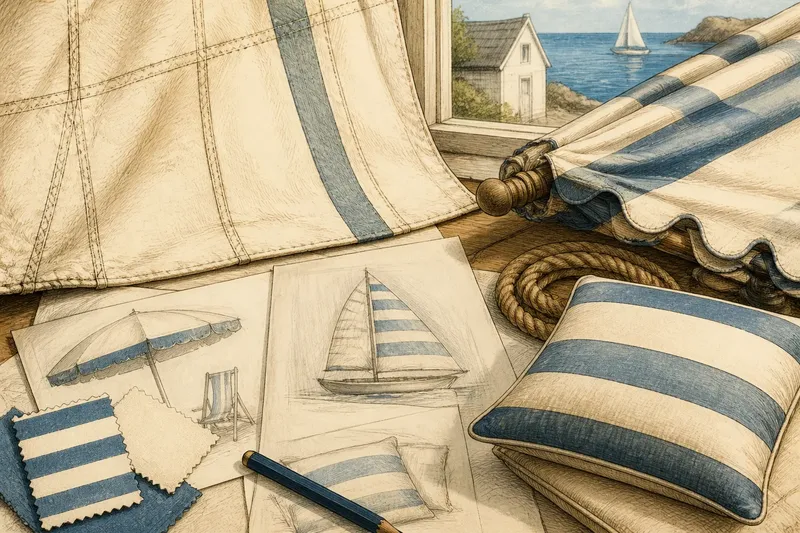
A striped canvas awning and a striped cushion may look related, but only one has to do with how cloth is assembled. Sailcloth to stripe is a useful way to trace how a practical material detail can become a decorative coastal motif—without claiming that every sail was striped or that the pattern has one origin.
Sailcloth and seams
Sails were made from cloth panels joined to form a surface that could catch the wind. On some sails, the seams and differences between panels were visible as lines; these were signs of construction, not necessarily decorative stripes. Sail appearance varied with the cloth, the way it was made and the vessel’s use.
It helps to distinguish three things that can look similar from a distance: a seam where pieces of cloth meet, a contrasting panel woven or sewn into the sail, and a line applied as paint or print. Appearance alone cannot tell you which one you are seeing, or why it was there.
From sail to image
Pictures and decorative objects can simplify what they depict. An artist might use a few bands to make a sail legible in a small print; a later cushion or shade might borrow those bands as a visual reference. This describes a plausible way the motif can travel, not a documented, universal progression from working sail to modern interior.
A striped object may evoke maritime life without copying a particular sail. Its pattern can also suit the object’s shape or provide a clear division of colour. The association comes from the object, its setting and what the viewer recognises—not from the stripe alone.
Say you have a plain canvas garden umbrella and want a coastal detail. You add one muted blue band to its valance, leaving the canopy plain; the visible result is a small contrast at the edge, while the umbrella still reads first as shade. If you repeat the band on a cushion, the two pieces look coordinated, but that pairing signals your design choice rather than a local tradition.
Reading the pattern
When you encounter a stripe, inspect the object before calling it nautical. These clues can guide an interpretation, though none establishes an object’s history on its own:
- Check the material: If the line is a seam in woven canvas, read it first as construction; if it sits on printed paper or glazed ceramic, treat it as a surface motif unless other evidence points elsewhere.
- Check its alignment: If a band follows a join between panels, consider a construction-related origin; if it crosses seams without regard to them, consider a decorative design instead.
- Check for applied colour: If paint or ink lies over the surface, consider marking or decoration; if the line is formed by joined cloth, consider construction. Appearance may still leave the purpose uncertain.
- Check the object’s use: If the stripe sits on a sail or canvas shade, ask whether it could serve a practical purpose; if it appears on a cushion or print, read it more cautiously as a reference.
- Check the surrounding materials: If rope, timber or metal fittings form part of the same object, consider a working context; if the stripe is paired with other interior patterns, consider a styling choice.
- Check for a specific place or maker: If a label or reliable provenance names one, keep your interpretation tied to that source; if neither is available, avoid assigning the pattern to a particular harbour or tradition.
Questions about sailcloth stripes?
Did every sail have stripes?
No. Sails differed in material and construction, and a visible seam is not the same as a decorative band. The tidy striped sail common in coastal imagery is only one possible visual reference.
Are blue and white the original colours?
Blue and white are familiar in contemporary coastal styling, but they do not describe maritime colour everywhere. A stripe’s colours may come from its material, a practical marking or a later design choice.
Can I tell whether a stripe was functional?
Look at the material, seams, placement and object around it, then keep the result provisional. Those details can suggest construction or marking, but they cannot by themselves prove the original purpose.
How can stripes feel coastal without looking themed?
Use them where the material and shape make sense, such as on a canvas shade, and keep neighbouring surfaces simpler. That lets the stripe read as a considered design detail rather than a claim about maritime history.
A flexible motif
Sailcloth to stripe is not a single, settled origin story. Seams and panels can supply visible lines; pictures and decorative objects can reinterpret them; viewers then bring their own associations. The distinction between a working feature and a decorative reference is often clear only when you consider the object as a whole.
When choosing or interpreting a stripe, ask what the line is made of, where it sits and what the object does. That close look makes the pattern more interesting: it may recall canvas construction, borrow a maritime mood or simply give a surface a clean rhythm, without standing in for every coast.