Rope, Timber or Stone: Reading a Harbour Edge
Read a harbour edge through rope, timber and stone: notice how each material marks a boundary, handles contact and shapes the feel of the working shore.
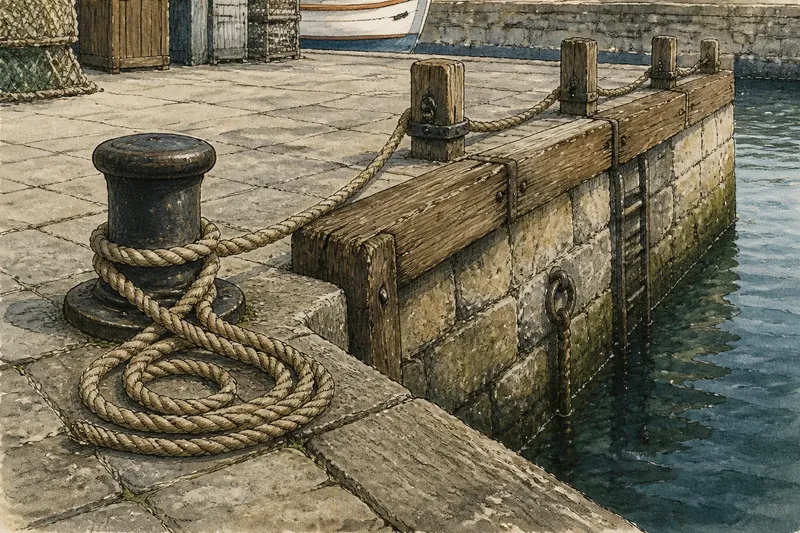
Rope, timber and stone make a harbour edge legible before you reach the water. Rope bends and gathers; timber gives the shore a workable surface; stone holds a line against tide and weather. Look closely and these materials tell you not only what a place is made of, but how people are expected to move, wait and work there.
These field notes focus on the ordinary details: a coil tucked against a bollard, boards polished by passing feet, a rough stone lip darkened by spray. They are not interchangeable decorations. Each material has a different relationship with touch, movement and the water beside it.
Rope marks contact
Rope is the most changeable of the three. It loops, sags and tightens in response to use, so it brings a harbour edge a sense of ongoing activity. A coil on a quay may look casual, but its placement can keep a working line close to hand and away from a walking route.
Look at how the rope meets its surroundings. It might be wrapped around a bollard, threaded through a ring or laid in a loose circle on the ground. The contact point matters: a line secured to a substantial fitting reads as equipment; a decorative length draped over a railing reads more like a maritime motif. Similar fibres can carry very different meanings depending on whether they are doing a job.
Texture changes the impression, too. A thick, tightly laid hawser has visual weight, while a slender line can appear almost graphic against stone or painted timber. Weathered fibres tend to soften the sharpness of a metal fitting, and a dark, damp rope can make the edge look freshly active even when the rest of the scene is still.
For a closer reading, follow a line with your eyes rather than assuming its purpose from a distance. Does it lead towards a mooring point, disappear behind a stack of gear or simply hang as a barrier? That small tracing exercise separates an object’s practical role from the atmosphere it creates.
Timber carries movement
Timber often forms the surface between land and water: a landing stage, a fender, a short run of decking or the side of a boat. Its grain gives the edge a direction. Long boards draw the eye along the quay; upright posts interrupt that flow and suggest places where a vessel might come alongside.
Wood also records contact in a visible way. Scuffed corners, softened edges and darkened patches can show where ropes rub, feet pass or water reaches. These marks are not a reliable maintenance report, and appearance alone cannot tell you whether a surface is sound. They do, however, make timber feel less abstract than a freshly finished wall: the material seems to keep a record of handling.
Notice the difference between boards meant to be walked on and timber used as a buffer. A broad, relatively even deck invites passage, while a thick horizontal fender at the waterline announces a protective role. In a single view, the first can make the harbour feel accessible; the second reminds you that boats and quay are liable to meet with force.
Timber can also soften a hard boundary without hiding it. Against pale masonry, a weathered brown edge reads as a warmer threshold. Against dark water, it may become a narrow, practical platform rather than a decorative feature. The effect depends on the surrounding surfaces, the light and how much of the wood is exposed.
Stone holds the line
Stone tends to make the harbour edge feel settled. A quay wall, stepped slipway or low parapet gives the shoreline a firm outline, even where the water shifts below it. Unlike rope, stone does not visibly gather or flex; unlike boards, it rarely suggests a route across the surface. Its dominant gesture is to mark where land ends.
Surface is the useful clue. Dressed blocks make a crisp, deliberate face; irregular stones create a broken pattern that catches shadow. Look for changes in colour near the water, where dampness or salt deposits may distinguish the lower courses from those above. Such variations lend depth to a wall, but they should not be mistaken for evidence about its condition.
Stone’s mass can make small fittings stand out. A ring, ladder or bollard fixed into a broad masonry face becomes a focal point because it interrupts a quiet field. The contrast also clarifies the division of labour: stone provides the steady background, while metal, rope or timber handles more immediate contact.
At the edge itself, the profile matters as much as the material. A vertical wall keeps a clean boundary; a sloped or stepped surface offers a visible transition towards the water. Neither shape is simply more welcoming. Each suggests a different kind of access, and the actual use of a harbour should be read from signs, barriers and local practice rather than inferred from appearance alone.
Reading a harbour edge?
What does rope tell you about a quay?
Rope signals connection, handling and temporary arrangement, especially where it meets a ring, bollard or other fitting. Its position can reveal whether it is part of working gear or simply contributing a nautical note.
Why is timber common beside the water?
Timber can form a usable deck, a boat-side fender or a small landing surface, each with a different relationship to movement. Grain, board direction and visible wear help distinguish these roles.
What makes a stone harbour wall feel different?
Stone reads as a continuous, durable boundary, with blocks and joints giving the edge a strong visual rhythm. Its mass can make smaller fittings and changes in waterline especially noticeable.
Can appearance show whether a surface is safe?
No: colour, wear and texture may offer clues about use, but they cannot establish structural soundness or safe access. Follow posted restrictions and seek advice from the harbour authority or a qualified professional if a condition raises concern.
Notice the joins
The most revealing details often sit where materials meet. A rope passing over timber can leave a dark groove; timber fixed to stone can create a narrow shadow line; a metal ring embedded in masonry can connect a flexible line to a rigid wall. These junctions show how the harbour’s parts cooperate without making every surface look alike.
Pause at a boundary and ask which material is doing the holding, which is taking the contact and which is guiding movement. A stone wall may hold the shore’s outline, a timber fender may absorb a boat’s approach, and rope may make the final connection. The combination reads as a sequence of roles rather than a collection of textures.
Say you are sketching an invented, quiet quay with a high stone wall, a timber landing and one coil of rope near a bollard. Start by noting the wall as the fixed boundary, then mark the landing as the route to the water and the coil as movable working gear. The expected result is a sketch that explains how the edge is organised, rather than one that treats all three materials as equal visual accents.
Read the whole scene
Weather and light can make the same material appear to change character. Damp timber deepens in tone; a pale stone face may lose its contrast beneath cloud; rope can stand out sharply when its fibres catch side-light. These are momentary effects, not changes in the material’s role, but they influence what your eye notices first.
Distance matters as well. From across a basin, rope may disappear into a thin line and timber may merge with a boat’s hull. Up close, their surfaces separate into fibres, grain and scuffs. Stone often remains legible at both scales because its broad planes hold their shape in the scene. Switching between a wide view and a close look prevents one dramatic detail from standing in for the whole harbour.
Use the same approach when taking notes or choosing a coastal reference for a room: record the material, its position and the job it appears to perform. “Weathered timber” is a useful start; “timber fender below the quay edge” is more specific. That extra context keeps a harbour detail grounded in the place it belongs to.
To read a harbour edge well, begin with the material nearest your eye, then follow its connections outward. Rope describes a link, timber often carries contact or passage, and stone gives the shoreline a firm shape. The junction between them is where the scene becomes most informative: a small, practical meeting point that explains how the harbour works and why it feels the way it does.